
Practitioner Fellowship
Purpose and Community
Launched as a pilot program in 2025-26, practitioner fellows are individuals whose work involves applications of behavioral science, such as journalists, policy practitioners, consultants, public servants, entrepreneurs, and other non-academics. They are intended to help bridge the work being done in traditional academia to the world, and are living examples of how the social and behavioral sciences are used across a number of sectors. They are selected to be curious about the work of the current fellows, have an interest in translating the work being done at CASBS to significant and everyday problems, and have a record of excellence in the practical use of social and behavioral sciences.
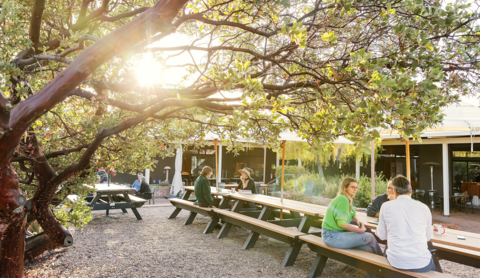
The majority of fellows in the CASBS community are academics working in a diverse range of disciplines and representing the core social and behavioral sciences (anthropology, economics, geography, history, law, political science, psychology, and sociology), humanities, education, linguistics, communications, and the biological, natural, health, and computer sciences. Academic fellows spend the year expanding their work and considering the way in which other perspectives might inform and deepen their understanding. Practitioner fellows should come with a healthy curiosity about academic work, and a willingness to share how they think about related problems from their unique contexts. The role is ideal for someone who already works in the behavioral sciences, believes that they would benefit from being around cutting-edge social science, and could contribute to how social science can be used to solve problems.
Expectations
Practitioner fellows can be in residence for the for the entire fellowship year (September – May/June), or have a shorter period of residence for the fall (September – December/January) or the winter/spring (January-May/June). They are expected to have an ongoing physical presence at CASBS throughout their fellowship period (at least three days onsite per week) and to attend all the orientation activities in September, weekly seminars during their residential period, and other events. This includes lunch at least three days per week. Practitioner fellows are active participants, sharing their knowledge of how social sciences are applied in their sector and beyond. They are also required to give a presentation about how behavioral and social sciences form and underlie the work they do as part of the regular fellows’ seminar series.
Practitioner fellows may not have commitments that result in prolonged or frequent absences from the Center. We ask all fellows to limit their travel to the absolutely essential for the fellowship year.
Application Process
The application for the 2027-28 year can be found here. You will be asked to supply a CV or resume, answer a few short questions, and provide a statement of the project you plan to work on during your time at CASBS. You will also need a letter of recommendation who can speak to your ability to engage in an intellectual community.
Applications are due on December 11, 2026. (The reference letter deadline is December 16, 2026.) Applicants will be notified of decisions via email by March 31, 2027.
Regarding the project statement, it should not exceed one page and answer the following question: What is your plan or focus for the fellowship year?
Concisely describe the work you plan to do during your fellowship year. Address what is original about the proposed work and what potential relevance it has to contemporary social issues. How will your project “make a difference”?
A strong consideration in the selection process is an applicant’s perceived ability to participate in ongoing cross-disciplinary conversations about their own work and that of others. The Center experience often has a transformative effect on fellows’ work plans, and your focus may shift during the course of the fellowship year.
Frequently Asked Questions about the Practitioner Fellowships
What items are needed to accompany my application?
All prospective fellows will need to submit the following materials with their application:
- Curriculum vitae (three-page maximum)
- Project statement (one-page maximum)
- One reference letter
My documents are Microsoft Word files. Can I submit those with my application?
No.
To ensure the integrity of your CV and personal statement, we can only accept PDF files. Creating PDF files from other formats, such as Microsoft Word, is easy to do. If you need assistance, please read these instructions on converting documents to PDF.
Are paper applications accepted?
No.
Applications are submitted only via an online application system.
Do I have to complete my application all at once?
Yes. There is not an option to “save” the application in process.
What are typical activities during the fellowship year?
Many activities offer fellows significant opportunities to engage with one another (as well as with others on the Stanford campus):
- a required weekly seminar series in which fellows present and discuss their work
- informal working groups that emerge during the year, giving fellows with broadly overlapping interests a basis for sustained conversation
- occasional symposia hosted by the Center
- daily lunches at the Center
- special events and recreational activities organized by the Center
- Stanford campus colloquia and seminars
What is the Center policy regarding health care benefits?
Neither Stanford University nor the Center provides health care coverage (or subsidies for health care coverage) to fellows or their families. International scholars should note that proof of health insurance is required during the J-1 (visiting scholar) visa application process.
What privileges does a CASBS fellow have at Stanford University?
Center fellows receive an official “Stanford fellow” designation and are given an identification card through which they are accorded library privileges at the Stanford University Libraries and sports privileges at Stanford's sports facilities.
What services are provided to CASBS fellows?
The Center provides a range of services designed to make fellows more effective and efficient while in residence, including:
- library research assistance
- desktop support
- fax and mail services
- limited administrative services
- pleasant work spaces at the Center
- housing information for relocating to the Palo Alto area for the fellowship year
Can fellowships be awarded for a single semester only?
Yes.
A fellowship may be awarded for the fall semester (September-December/January), spring semester (January-May/June) or full fellowship year (September-May/June).
What financial support is provided?
Small stipends may be available to supplement base salary support or for housing support. Housing support will be considered for practitioner fellows coming to CASBS from out of the area. For our purposes, this means greater than a 15-mile radius of the Center and moving within a 15-mile radius for the residential period. Any financial support will be determined in spring 2027, after the selection process has been completed.
Are non-US citizens able to receive CASBS fellowships?
CASBS welcomes international scholars, who must be eligible to come to the Center on a J-1 scholar visa. To check your eligibility, inquire with your nearest US consulate, or read the information about J-1 scholar visas at Stanford’s Bechtel International Center website.
Is there space and are there services for spouses and partners?
Spouses and partners are invited to participate in some aspects of the intellectual and social life of the Center. Staff support services are reserved for CASBS fellows.
If your question is not answered here, please contact Sally Schroeder at casbs-fellowships@stanford.edu.