As a teenager growing up in Turkey, Daron Acemoglu thought about and read what he could on the political and economic problems confronting his country. This was formative enough for him that, based on this, he decided to study economics.
“Little did I know that’s not what most of economics covered. But then when I realized what economics was, I loved that, so I stayed with it…it was a good decision.”
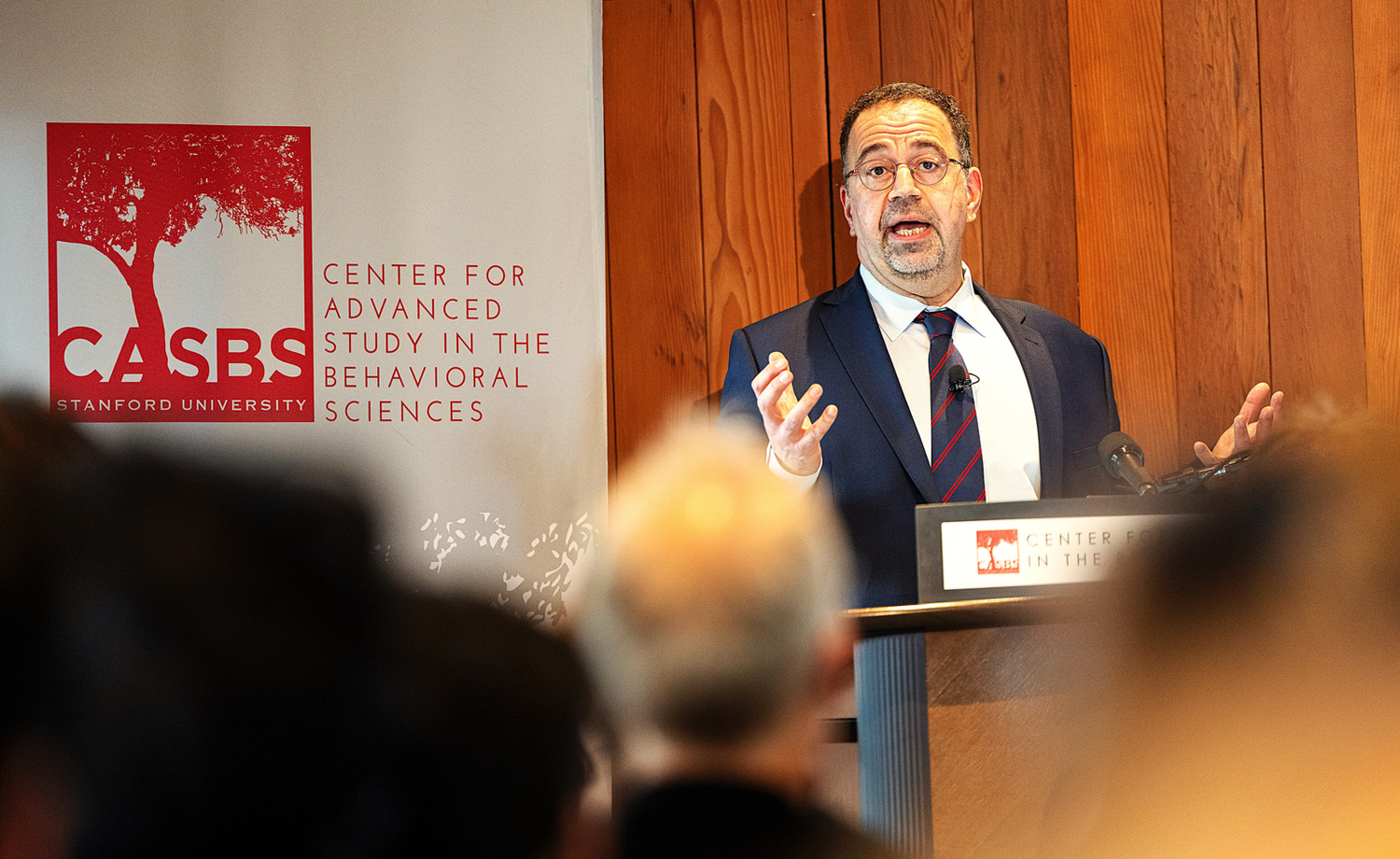
The understatement of the year from the 2024 Nobel Prize winner in economics elicited a collective chuckle from the overflow audience, assembled to hear him deliver the 2025 Sage-CASBS Award Lecture – “Institutions, Technology and Prosperity” – on April 24, 2025, at CASBS.
In January 2025, CASBS and its partner, the academic publisher Sage, announced Daron Acemoglu as the ninth winner of the Sage-CASBS Award, established in 2013 to recognize outstanding achievements in the social and behavioral sciences and their role in advancing public discourse, public policy, and good governance. By tradition, each winner delivers a public lecture at CASBS, with Sage as co-presenter.
Though it was Acemoglu’s first visit to the Center, CASBS is, of course, very accustomed to hosting economists in its annual fellowship cohorts. And this includes some pretty eminent ones – of an impressive 30 CASBS fellows who have won the Nobel Prize, 25 were in economic sciences. Among them are some one-word names you know. Arrow. Friedman. Stigler. Solow. Coase. North. Kahneman. Williamson. Thaler.
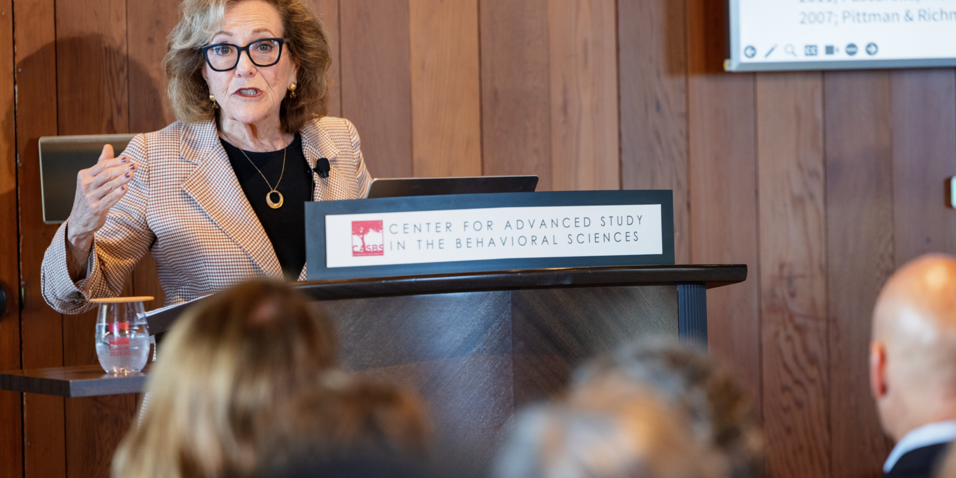
Daron Acemoglu’s appearance at CASBS on April 24 was a draw for several elite economists. Earlier in the day, Guido Imbens (Nobel Prize, 2021) and Paul Milgrom (Nobel Prize, 2020 and two-time CASBS fellow) joined him, CASBS director Sarah Soule, and several current CASBS fellows for lunch. Later, Milgrom and Alvin Roth (Nobel Prize, 2012) were in the audience to witness Acemoglu’s Sage-CASBS Award Lecture. Others on hand for the talk included 2004-05 CASBS fellow Susan Athey, the Economics of Technology Professor at Stanford; Katherine Casey, the The RoAnn Costin Professor of Political Economy and Faculty Director of Stanford’s King Center on Global Development; Mark Duggan, the Wayne and Jodi Cooperman Professor of Economics at Stanford; 2005-06 CASBS fellow Matthew Jackson, the William D. Eberle Professor of Economics at Stanford; and Amit Seru, the Steven and Roberta Denning Professor of Finance at Stanford.
Also notable were the three dozen or so Stanford economics, political science, and history graduate students on the attendee list, eager to hear Daron Acemoglu speak.
And for good reason. Acemoglu, an Institute Professor at MIT, is renowned for a body of work that involves all three disciplines. He interrogates the causes of long-term economic growth and the comparative study of prosperity among nation-states, gaining attention in the public consciousness through trade books such as Why Nations Fail, The Narrow Corridor, and, most recently, Power and Progress: Our Thousand-Year Struggle over Technology and Prosperity. It’s for these works and others that Acemoglu and his frequent collaborators, James Robinson and Simon Johnson, were awarded the 2024 Nobel Prize in economic sciences.
View a photo gallery from the 2025 Sage-CASBS Award Lecture
Central to much of Acemoglu’s work is the importance of inclusive economic and political institutions for sustained growth and development. And as CASBS director Sarah Soule noted in her introduction of Acemoglu on April 24, this resonates deeply at a place like CASBS, where many social and behavioral science scholars undertake work that accounts for the role of institutions and how they influence incentives and opportunities. And though much of Acemoglu’s previous work shows how institutions mattered in specific ways during colonial periods and other expanses of human history, his talk at CASBS aimed at demonstrating how both institutional legacies and contemporary institutional choices matter now and will continue matter into the future, particularly in their interrelationship with policies involving technology innovations. Linking with his current work as faculty co-director of MIT’s Shaping the Future of Work Initiative, he offered a connecting framework that provides a more holistic account of how institutions evolve and impact technology and prosperity.
Acemoglu basically put on a master class at CASBS. As he shared with the audience with the aid of a number of explanatory slides – and as he has presented more formally in the American Economic Review – the framework, anchored by what he calls a ”utility-technology possibilities frontier” (UTPF), elucidates possible distributions of societal resources for both given technologies and different technology choices. Technological choices are critical for prosperity and the distribution of prosperity; both, in turn, are intertwined with institutional trajectories. The framework, accordingly, provides a more holistic account of how institutions evolve and impact technology and prosperity.
Acemoglu showed how shifts in the UTPF result from institutional arrangements, arguing that many of those shifts relate to technology (at about the 33-minute mark in the video above) and how different types of forces distorting technology-institutional choices can in turn serve as forces for both (positive and negative) political persistence and political change, referencing work with James Robinson found most notably in their coauthored book Economic Origins of Dictatorship and Democracy.
With the accompaniment of slide after slide, Acemoglu methodically built the case for his framework of institutional change (or stasis, as they case may be), applying it (beginning at about the 41-minute mark) to historical “critical junctures.” Readers will recognize the term; Acemoglu and Robinson extensively chronicled examples of them in their landmark book Why National Fail: The Origins of Power, Prosperity, and Poverty. Such junctures – as occurred during periods of colonial governance as well as during episodes of industrial revolution and other major advancements in industrialization, such as the establishment of railroads – constitute points of disruption and divergence that often unfold in contingent or stochastic ways between those holding a society’s political and economic power and those who do not.
“You cannot ex ante always know which of two similar societies is going to loosen its institutional grip and which is going to double down on it,” Acemoglu noted.
Eventually (at about the 48-minute mark), Acemoglu carried forward his framework. Even today – perhaps especially today – institutions are still key. The same ones still matter. The framework, he argued, enables us to see how, during critical junctures, existing and often very small differences in institutional settings can exert amplified effects on prosperity and (institutional) trajectories.
Accordingly, he suggested some parallels between historical disruptive periods and current approaches to the development and deployment of artificial intelligence and other digital technologies today. Moreover, Acemoglu noted (at about the 58-minute mark) that many economists and others observing and analyzing the slide in support for democracy around the world we’ve witnessed link one of its principal causes – increasing economic inequalities – to (institutional) choices about how to use these technologies for, say, automation purposes, and how resulting outcomes disrupt the balance between industrial productivity and the welfare (as well as political power) of workers. From the 1970s onward, digital technologies generally have created new pathways for saving or shedding labor costs, thus benefiting economic elites more.
“This is a real twist,” said Acemoglu. “[I]t’s making things much harder for labor because the pathways for labor to take a slice from the increased productivity or increased prosperity are being curtailed because of automation. Now that itself could be viewed as a critical juncture” leading to any number of potential changes in the political trajectories of society.
So, too, with AI. How it is used will have implications for both the distribution and the efficiency of production, he explained. We find ourselves at a moment where AI could be used in a more pro-worker direction to create new pathways for them, enabling them to boost skills and expertise, and increasing the sophistication of tasks they can perform. If countries like the U.S. do that, the “twist” Acemoglu spoke of could move in reverse.
“It’s an institutional choice to influence how we use technology and what direction it’s going to go in.”
View Daron Acemoglu’s Sage-CASBS Award Lecture, including presentation of the award plaque by Sage representative Doug McCune, above or on CASBS’s YouTube channel.