At the Forefront of Prediction Research: Q&A with Elena Esposito
With expertise and work bridging classic sociological systems theory and the sociology of digital media, 2025-26 CASBS fellow Elena Esposito has published extensively on the theory of society, media theory, fashion, memory, and the sociology of financial markets across 12 books and more than 250 authored or coauthored articles or book chapters. She also brings a cross-disciplinary approach to her work that combines sociology, philosophy, and media studies to better understand contemporary social complexities. In recent years, Esposito has positioned herself at the forefront of research on prediction, forecasting, and algorithmic probability in modern society. She pursues this work through faculty appointments at both Bielefeld University, Germany, and the University of Bologna, Italy.
Her CASBS-year project, a highly anticipated book, elucidates mechanisms and social consequences of combining statistical modeling and predictive machine learning algorithms across contexts. It flows from previous work that situates digital technologies such as machine learning in terms of artificial communication rather than artificial “intelligence,” as well as from a collaborative initiative she leads on algorithmic prediction at Bielefeld. In 2019, the initiative earned multi-year support from a prestigious European Research Council grant. In 2021, Esposito earned the social sciences and humanities Science Breakthrough of the Year from the Falling Walls Foundation for her work on how algorithmic forecasting disrupts the principle of shared uncertainty.
We conducted a Q&A with Elena to learn more about her current work.*
CASBS: The endowment that funded your fellowship prioritizes research oriented toward more accurate and unbiased anticipation or prediction of future events to avoid perils and create opportunities. Your CASBS-year proposal, submitted as part of your application for fellowship, is a book project “on the general theory and practice of prediction in digital society.” Tell us more about the book-in-progress and how it reflects this alignment of interests.
Elena Esposito: Yes, the starting points are exactly the same: the idea that today it is increasingly important to be prepared for future events, which can be threats but also opportunities. This is happening just as prediction is changing in the age of algorithms. The central argument of my book is that AI and machine learning are not simply making traditional forecasting more accurate. They are introducing a fundamentally different way of relating to the future.
Our familiar forms of prediction, based on probability and statistics, rely on models that explain the world and estimate likely outcomes. Algorithmic prediction works differently. Rather than seeking causal explanations, machine-learning systems identify patterns in vast amounts of data and continuously adapt as new information becomes available. Their strength lies not in “understanding” the world, but in learning from uncertainty and responding to surprises. This, of course, presents great opportunities but also significant risks: just consider the issues of bias, opacity, and misalignment associated with algorithms. The book assumes that to manage these issues appropriately, we must start from the specificity of algorithms, which do not think like us and produce their results in ways that may be incomprehensible to us. This was the central theme of my previous book, Artificial Communication (MIT Press, 2022), which I build on and develop further here.
My new book outlines a general sociological theory of this transformation. It traces the historical evolution of predictive practices, examines the distinctive logic of algorithmic forecasting, and investigates its practical consequences in fields such as medicine, insurance, and policing. Across these cases, a common tendency emerges: The goal is less to foresee a fixed future than to intervene in unfolding situations, create new possibilities for action, and to learn from the results.
CASBS: Your book will be the crowning output of a larger research program, The Future of Prediction, that you and your collaborators and students have been pursuing at Bielefeld University for years. What are the aims of the program and how does its efforts thus far inform the book you’re working on at CASBS?
Elena Esposito: The material that provides the empirical basis for my project comes from the research we have conducted over the past six years, which has shown us how the ideas that initially guided the development of predictive algorithms have changed in practice. It was generally thought that statistical models based on explanation would be incompatible with opaque algorithmic models. Instead, we have seen that in all the fields we analyzed the two types of approaches are being combined. In medicine, for example, the use of algorithms has made it possible to combine prognostic biomarkers, which predict who will develop a given disease, with predictive biomarkers, which predict whether a given treatment will work for a specific patient. This allows for more effective treatment of individual patients, yielding results that also help advance research and develop new treatments.
These examples show that what is often considered a liability of algorithms can also turn out to be an advantage: these systems make predictions based on the patterns they find in the data, without “understanding” the meaning of the material they process. But sometimes the correlations underlying these patterns allow for predictions to be made in individual cases even without explaining the underlying mechanisms – that is, without understanding the causes. And such predictions then can be used to advance scientific research and the pursuit of explanations. Predicting without understanding (if done in a controlled manner), ironically, can lead to a better understanding.
CASBS: How will the book engage with and extend current sociological theory, and why should that be important to non-sociologists?
Elena Esposito: The social ways of managing the uncertainty of the future and how they change across different times and societies are a classic topic in sociology. There is insightful research on the conditions of an open future, on how the perception and management of risk change, on preparedness, and on the social effects of predictions. A central theme, for example, is performativity: the condition whereby a forecast tends to affect the future it predicts, especially if it is authoritative and of high quality, because people follow it and decide, for instance, not to travel during times when heavy traffic is expected, thereby falsifying the forecast. There is also fascinating sociological research investigating the practical effects of the distinction between explanatory models and predictive models in the social sciences, arguing that the latter are not necessarily less accurate or less useful.
My book draws on all this research and integrates it with the entirely new findings we have derived from studying the social use of predictive algorithms. The models in the research are explicitly designed to predict without explaining, and they treat performativity as a resource rather than a problem. I have also observed the emergence of novel, dynamic forms of prediction that use their own results to update the very structure of the models.
Outside of sociology, it will be important to have a framework for understanding how to deal with a future that depends increasingly on our behaviors and that, precisely for this reason, is becoming increasingly unpredictable.
CASBS: How will theory inform practice? The book will apply its insights across some key domains: policing, precision medicine, personalized insurance, and digital society in general. How will a science of algorithmic prediction work as a practical matter?
Elena Esposito: The results can be enlightening. In policing, for example, we have shown that algorithms are useful not for arresting criminals before they commit a crime, but rather for guiding the development of targeted and effective prevention policies. Or in the field of insurance: the precise information provided by algorithms on the risk of accidents or illness for individual people is not useful for calculating policy prices or rates, because then only those who don’t need them could afford to buy them. Instead, they are used to develop personalized coaching services to reduce the likelihood of harm. In general, algorithms enable us to intervene more effectively in a future that does not yet exist, continuously updating our predictions.
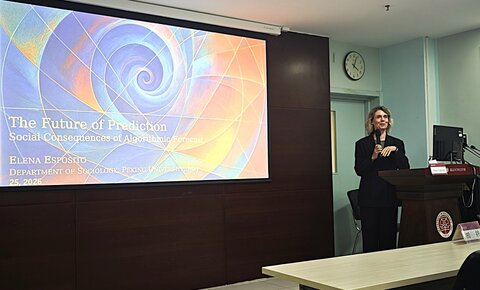
CASBS: You have a book in you, one way or another. But how, if at all, has spending an academic year at CASBS influenced the trajectory of the work? You delivered a CASBS research seminar talk and collected feedback from political scientists, psychologists, philosophers, economists, historians, journalists, communication and media studies scholars, etc. Do you expect that the book will come out differently in some way as a result of being here?
Elena Esposito: Without a doubt. The constant exchange with colleagues who become friends through daily interaction is not only a great pleasure but also a rare opportunity to break free from one’s own disciplinary blind spots. By conversing in a relaxed and uninhibited manner, one learns to view one’s own research from the outside, discovering not only what is unconvincing but also what had convinced us simply because we had not questioned it. And then the routine of continuous, serene work over many months with the best possible support is a now-rare opportunity to raise the standards of our work.
CASBS: What about interactions across the Stanford campus? The CASBS fellowship affords access to world-class scholars and research infrastructure.
Elena Esposito: This, too, is a tremendous asset. For me, in particular, working on algorithms that are evolving at an unprecedented pace, being at Stanford and in Silicon Valley has been an invaluable opportunity. With the support of CASBS, David Stark (another fellow) and I organized a workshop on the social impact of algorithmic fictions in collaboration with the Stanford Center for Human-Centered AI, which included the participation of many highly talented young colleagues, PhD students, and post-docs. It was extremely useful and productive. So, too, was my participation in several events on campus, such as the AI for Organizations Conference and the Generative AI Field Research Workshop. Interacting and discussing with so many scholars and centers contributing to these transformations not only kept me up to date but also allowed me to witness progress from the inside. It fostered a confidence and creativity that otherwise would have been unattainable and provided many precious contacts for the future.
*September 2026 update: Elena Esposito was named winner of the 2026 Balzan Prize for the Social Science of Digital Technology by the International Balzan Foundation. The foundation's announcement cited Elena for a concept discussed in the above Q&A: 'artificial communication' and its reframing of artificial intelligence through Elena's demonstration that algorithms can participate in social exchange in the absence of understanding.