Robert Putnam's CASBS Roots
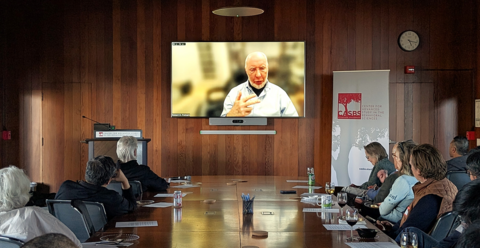
On Thursday, March 6, 2025, the CASBS community gathered to celebrate the work of renowned social scientist and two-time CASBS fellow (1974-75, 1988-89) Robert D. Putnam. Bob himself appeared live on Zoom to introduce a special screening of “Join or Die,” the 2023 documentary film that explains, through Putnam’s work and career, the importance of civic engagement and community connection and the implications for flourishing democratic societies. (View “Join or Die” on Netflix.)
Bob, of course, became well known in the public consciousness through landmark books including (but not limited to) Bowling Alone: The Collapse of Revival of American Community, Our Kids: The American Dream in Crisis and, most recently, The Upswing: How America Came Together a Century Ago and How We Can Do It Again. (On publication day for “The Upswing,” Putnam appeared in a live CASBS webcast episode, “Can We Rebuild Social Cohesion in the U.S.?” along with Danielle Allen, David Brooks, Shaylyn Romney Garrett, and Eric Klinenberg. View the webcast video.)
However, the project that started Bob on his trajectory toward the National Humanites Medal, among many other honors and accolades – initially referred to as “the Italian regional study” when he worked on it during his 1974-75 CASBS fellowship – eventually became the book Making Democracy Work: Civic Traditions in Modern Italy. It’s Putnam’s first work exploring the concept of “social capital” – networks of productive interpersonal relationships that help individuals and groups advance purposeful goals.
The project took about 25 years, as Putnam explained to the assembled CASBS crowd on March 6. His second, 1988-89 CASBS fellowship “was meant to be the year in which I finished the study.” The book finally was published in 1993. “I owe a tremendous amount – not merely to the release time and the beauty of the Center,” Putnam said – "but also to the interdisciplinarity of the Center, because there were many, many people during both fellowship years, 1974-75 and 1988-89, who went out of their way to volunteer to help. So, my heartfelt praise and thanks to the Center.”