Board Member Spotlight: Mubarik Imam
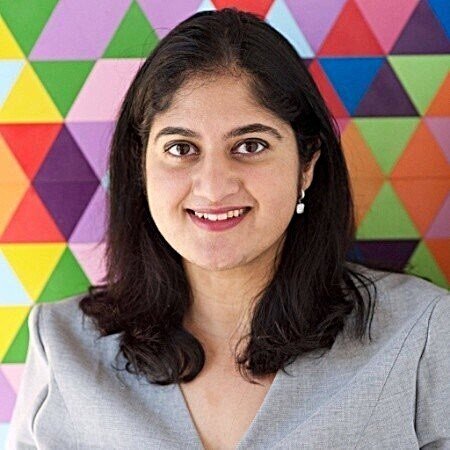
Mubarik Imam, a CASBS board member since 2023, has put together what looks like a dreamy Silicon Valley resume. Stops at Dropbox and the Packages Group followed a stint as an associate consultant with Bain and Company and as a Global Fellow with the Acumen Fund. Eventually, there was a confluence of timing, talent, and opportunity. Mubarik was an early employee at WhatsApp and during her tenure was involved in several major company initiatives and supported teams for Growth, Integrity, Monetization, Analytics and Research. She was closely involved with Facebook’s acquisition of WhatsApp and its integration. Mubarik also spent time working on Meta’s Health team, assisting with the company’s Covid response through its frontline workers and health systems. The educational platform that launched her career includes a Bachelor’s in electrical engineering from MIT, a Master of Public Administration from Harvard’s Kennedy School, and an MBA from Stanford.
But the journey started in Pakistan, where Mubarik was born and raised and where she still visits several times per year. We did a Q&A with Mubarik to dig a little deeper and learn more about her.
CASBS: Let’s start with what you’re known for in the tech world. You helped facilitate Meta’s integration into WhatsApp, and notably led WhatsApp’s nine-fold growth over seven years into a platform with more than 1.8 billion users. Are there any lessons you learned along the way about leadership as well as quick and massive scaling?
Mubarik Imam: I did! I can distill it down to four things. First, focus is the new “F” word was a mantra I helped coin at WhatsApp – it even found its way on our swag. Focus isn’t about saying no to bad ideas but to saying no to 99 good ideas so you can work on the one great idea. As a start-up, the company felt like a library inside – it was extremely quiet when you walked into the space and everyone was heads down focused on getting work done and very mindful of honoring/preserving maker time. This was in stark contrast to a large company where the founders had worked and spent a ton of time in meetings.
Another relates to people: Work with people who you trust and want to spend time with. When I walked into WhatsApp it felt like a mini United Nations. Those global perspectives in a microcosm were essential for designing a product that was globally relevant. Also, it’s cliché but true: treat others the way you want to be treated. No task was too big or small for the founders to work on – from taking out the trash, to setting up a computer for a new hire (me). Work with people who you respect and admire; life is just too short.
Third, my colleagues and I learned that growth hides many problems: When you are scaling fast you have to ruthlessly prioritize so you don’t end up spending time on the things that don’t matter.
And finally, think from first principles: I loved working with Jan Koum and Brian Acton, WhatsApp’s founders, and learned from them the idea of independent reasoning from the ground up. It often involves being able to answer five why’s? for any question to help figure out fundamental truths and ideally find novel solutions. It was in stark comparison to reasoning by analogy which is more prevalent in other industries, like consulting, where at least some of the time you’re thinking about what you’ve seen before and how it can be applied to the work you’re doing. I had a fair bit of unlearning to do.
CASBS: You’re certainly not tech-siloed, though; your broader interests lie at the intersection of technology, business, education, and policy. Your educational background reflects this. Are there elements of your (pre-college) upbringing in Pakistan that inform or provide a window into our understanding of your path or interests?
Mubarik Imam: I was raised mostly by my grandparents and they had a big influence on my life (in addition to my parents). My maternal grandfather is one of the leading entrepreneurs in Pakistan and also served as Pakistan’s finance minister. He has committed much of his life to philanthropy and helped found the Lahore University of Management Sciences (LUMS), the NAQSH School of Art, and the Ali Institute of Education. So, I grew up with a strong ethos of to whom much is given, much is expected. My grandmother would repeatedly tell me that the most important thing is to acquire knowledge because no one can take that away from you. (During Pakistan’s nationalization in the 1970s my family lost six of their seven businesses overnight and had to rebuild. )
And as a woman growing up in Pakistan, I never took for granted that had I been born on a different street or in a different neighborhood, there was a significant chance that I would never have gone to school (let alone had the opportunity to study further). But I wanted to create my own identity – and not be known as anyone’s daughter or granddaughter.
For as long as I can remember, all I wanted was to become an astronaut. I really wanted to go to space to be able to look down on earth and really see it as one (as well as our insignificance in the universe). That’s what took me to MIT. But at the end of my sophomore year, after taking unified engineering (often the hardest part of aero-astro), I realized I was claustrophobic and switched to electrical engineering…
CASBS: What’s something notable about Pakistan, or the part of it in which you grew up, that we really should know but may not?
Mubarik Imam: Pakistan has incredible talent, and in terms of topography we’re blessed with everything from the Himalayas (with snow leopards) to the desert. People are exceptionally hospitable. My father, who was a farmer, would often tell me how Pakistan has the largest contiguous irrigation system in the world, known as the Indus Basin Irrigation System, covering over 47 million acres of farmland. The Indus Valley Civilization, the oldest civilization (dating to 2600 BCE) was one of the first urban cultures featuring advanced city planning and sanitization.
CASBS: You’ve surely followed in your grandfather’s footsteps in one respect; you founded and for nearly a decade directed a nonprofit called the Association for the Development of Pakistan. And you currently sit on the Advisory Board of the Syed Babar Ali School of Science and Engineering at LUMS, which notably takes a trans-disciplinary approach to education. What motivates these involvements?
Mubarik Imam: Of course, on a personal level, my grandfather invested much of his life in setting up LUMS and so it’s an honor to help continue that legacy. Beyond that, though, I really believe that while talent is distributed equally, opportunity is not. That is why I’m so passionate about the work at LUMS. It is the leading institution in Pakistan that is helping find the best talent from over 700 towns and villages. Learn about its national outreach program. For Pakistan’s economy to progress, it really needs to invest in science and engineering; I want to contribute as best I can to solutions.
CASBS: The Center, of course, is renowned as a place for trans-disciplinary learning and exploration. When and how did you first become aware of us?
Mubarik Imam: Sarah Soule and I had served on the Beyond Covid Taskforce at Stanford’s Graduate School of Business (when Sarah was GSB’s senior associate dean). When she moved over to CASBS she, along with board chair Abby Smith Rumsey, invited me to join the board. It is a pleasure to work with and learn from many of our board members.
CASBS is so lucky to have had Sarah, if only for a couple of years. [Editor’s note: It was announced in early 2025 that Soule would begin an appointment as dean of Stanford’s Graduate School of Business in June.] The Center’s loss is truly Stanford’s gain. But I’m really passionate about her vision to evolve CASBS and look forward to serving as a bridge to the Center’s next director. With the pace of technology evolving more rapidly than ever in human history, I am passionate about the role that CASBS can play in convening stakeholders from across policy, academia, and industry to help address some of the most pressing issues of our time. For example, what is the role that AI will play in our children’s development? How do we raise independent-thinkers in a world that is influenced by algorithms? How do we best prepare governments, especially in lower and middle income countries, for a world where many entry-level white collar jobs will disappear (while they undergo a massive youth bulge)? How do you democratize access to AI so that it benefits all of humanity, including last-mile users? Will universal basic income get distributed across the world and, if so, how?
CASBS: The CASBS board convenes twice per year at CASBS. Among other things, board members spread themselves out across several tables and eat lunch with CASBS fellows. What are your takeaways from these lunches?
Mubarik Imam: It has been fascinating to talk with researchers on topics where we’ve been on different sides. For example, we had a really rich discussion on understanding how researchers uncovered Russian influence on American elections and the Cambridge Analytica scandal. I was able to share the perspective of having helped build WhatsApp’s first integrity team that worked across various issues (elections, terrorism, child endangerment, spam, etc). I am continually inspired by the breadth and depth of our fellows’ research areas and expertise.
CASBS: What do you do for fun? Is there something you've read in the past year or two (book, article, fiction, non-fiction, whatever) that really struck you, influenced your thinking, or otherwise just blew you away, and why.
Mubarik Imam: I am relearning the piano, Kathak (after a 25 year hiatus), and Latin dance; it only took me a decade to convince my husband to take lessons together! I love landscape photography and, when I can get away, I love the freedom and perspective that comes from piloting a single engine aircraft. While it’s not as far up into the atmosphere as I would like, it is a step closer to realizing my childhood dream…
There are so many books – it’s really hard to pick one! Perhaps the book I’ve recommended most to my friends recently is Being Mortal by Atul Gawande. It’s that season of life where I have a grandfather whose 99 and a grandmother whose 95. The book has helped me understand and delineate what is important to caregivers vs. those who are aging. It also has helped me reflect more deliberately about what truly matters at the end and to think about whether my priorities are consistent with that. To quote the poet Mary Oliver, “What would you do with your one and only precious life?” I want to figure out how I can best honor that.
CASBS: What are you working on these days? What’s fueling your intellectual curiosity?
Mubarik Imam: I’m a techno optimist, so I think this is such an exciting time to be alive. I am passionate about the opportunity that AI offers to democratize previously scarce resources in health and education, particularly in the Global South. In fact, CASBS and Stanford’s Center for Digital Health co-hosted a convening on generative AI in healthcare in lower and middle income countries. Sarah Soule, former CASBS program director Zack Ugolnik, and I were among the contributors to a white paper that came out of it.
I am involved in helping setup initiatives for Health, Education & AI in Pakistan and advising foundations on AI. At the same time, I am also cautious about the potential for job displacement risk for entry level positions, particularly in lower and middle income countries that will be hit the hardest. I am increasingly concerned that society, including many governments in the Global South (with a few notable exceptions), are unprepared for the rapid pace of technological change and its far-reaching implications.
As a parent, I am curious how AI will impact our children’s generation in a deep and profound way. My son (9) and I are building a robot that can tell sports scores using LLMs, Raspberry Pi, etc. However, as an extension of that, he wants to build a robot that will be his friend.
As I write this (in early June), I just taught the final session of a new course, Negotiations Lab, at Stanford GSB alongside Professor Jon Atwell. We call it a lab because we want students to have the freedom to experiment, encourage them to extend beyond their comfort zone, and show them different ways negotiations manifest over the arc of their careers and their life. In short, the goal is a much broader view of negotiations that involves collaboration and problem solving. Most of our life is a negotiation – my toughest negotiators are ages 9, 6 and 3! The class blends negotiation theory with real-life situations, brought to life by incredible guest speakers who are experts in their domains. It was both a joy and a privilege to be back in the classroom — learning from our brilliant students, getting to know them one-on-one, and supporting them through their journey.
Also, I just finished writing a children’s book titled The Fearless Perwin, a tribute to my grandmother. I want my children to understand that they stand on the shoulders of giants — that their strength comes from the generations before them. As they grow up as Muslims in the United States, it’s also deeply important to me that they see Muslim women for who they truly are around the world: bold, independent, and adventurous — not confined to the tired stereotype of being submissive or oppressed. The illustrations are done and I hope to see the book in the world this year!
Q&A conducted by Mike Gaetani