Immigrant Cities and Democracy's Future
Issues surrounding immigration are among the most contentious and divisive of our time, both in the U.S. and other parts of the globe. In many industrialized and industrializing countries, urban environments, in particular, provide grounds upon which immigration stress-tests the strength of democratic values, institutions, and practices. Can cities transformed by immigration ensure that migrants contribute to urban development in a way that allows them and long-time residents to flourish together? What lessons can we draw from the experience of immigrant cities?
Such questions fuel the research of social and behavioral science scholars as well as the actions and advocacy of practitioners in the field. They also motivated a public event hosted by CASBS on May 6, 2026, and presented in partnership with Stanford University’s Institute for Advancing Just Societies. The event also served as the fourth and final Robert A. Scott Lecture, honoring legendary former CASBS associate director Bob Scott, who was in attendance with his wife, Julia Fremon. The May 6 event was produced with partial support from a lectureship fund established in Scott’s honor in 2015.[1]
Listen to this event as a podcast episode
Tomás Jiménez served as event moderator and a key synergistic bridge between the two co-presenting organizations. Jiménez is the Joan B. Ford Professor of Sociology at Stanford; his research focuses on immigration, assimilation, and ethnic and racial social mobility. He currently serves on the CASBS board of directors and, while in residence as a 2012-13 CASBS fellow, wrote much of his book The Other Side of Assimilation: How Immigrants Are Changing American Life. He is also the founding faculty co-director of the Institute for Advancing Just Societies (IAJS). IAJS’s Flourishing Cities Initiative seeks to examine movement between nations and how, in that context, to produce thriving communities.
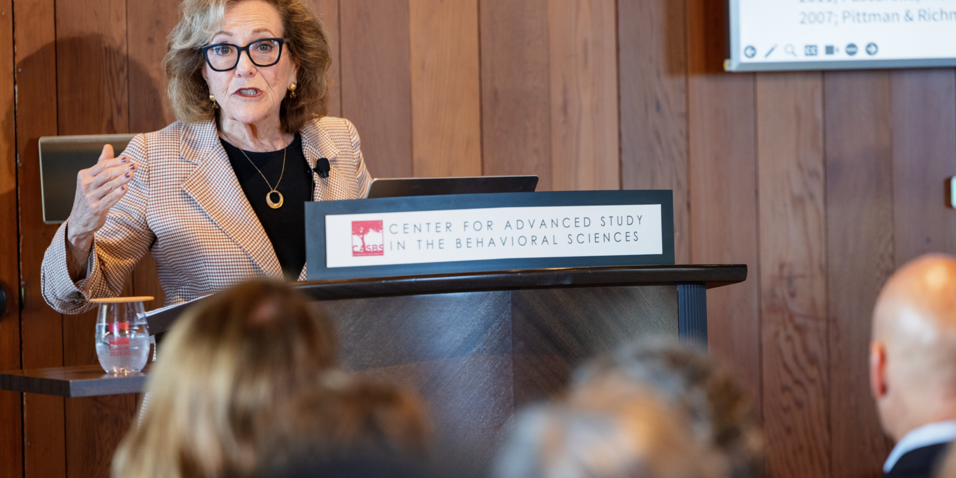
Among IAJS’s collaborators in the initiative is Welcoming America, a nonprofit that supports the prosperity of cities and towns by ensuring that everyone – immigrants and the long-established communities in which they reside – belongs. Welcoming America’s executive director, Rachel Perić, served as a panelist for the May 6 event. Perić was joined by University of Oxford economist Ian Goldin, a 2025-26 CASBS fellow, former World Bank vice president and economic advisor to Nelson Mandela, and author of many books including Age of the City and The Shortest History of Migration.
People have moved across societies for as long as we’ve had societies. It’s a feature of human behavior throughout history that continues today. As Ian Goldin pointed out, in the part of the world where Stanford resides – Silicon Valley, whose population is 41% immigrants – migration is widely acknowledged as a source of economic innovation as well as social and cultural dynamism. But that dynamism – and the diversity that immigration creates – can be a source of strain, whether real or perceived, in many places. In other urban areas of the U.S., especially in 2025-26, we’ve seen what Rachel Perić called the “split screen” of urban immigration – the targeting of vulnerable populations (though, paradoxically, sometimes pursued through seemingly indiscriminate immigration sweeps), on the one hand, and the outpouring of neighbors and allied communities standing up for one another, embodying democratic values of mutual protection and solidarity. Cities with significant immigrant populations have become the front lines where fundamental democracy-related questions will get answered. Will due process protections hold? Will neighbors defend one another across lines of citizenship status? Can local institutions resist federal overreach?
View a photo gallery of this event >
Though these appear to be open questions in some places, certain empirical findings stand regarding immigration’s effects on urban life. As Goldin stressed, cities with higher shares of immigrant residents consistently rank as the most livable – a pattern that holds across multiple measures of quality of life, economic opportunity, and social cohesion. There simply is no correlation between high levels of immigration and anti-immigrant sentiment in the same place. For example, though the U.K. as a whole voted to leave the European Union in 2016 (with “Brexit” occurring in 2020), 70 percent of Londoners voted against it.
“The most immigrant cities are the most tolerant cities, and also the most livable and happy cities, and the most thriving cities,” Goldin said. “And that's a generalization that goes from Melbourne and Sydney through London and Paris to the U.S. as well. What Silicon Valley has experienced is a generalizable historical phenomenon about what drives growth.”
In terms of a mechanism for this, Goldin pointed to a virtuous cycle in dynamic cities in which people do better economically, create more jobs, and generally see a brighter future. Those people attract more people, particularly young people. Increasing diversity attracts more young people because they want to be in community with those who are like-minded. They don't want to live in places that can’t attract the clubs, clothes, fashion, food, music, and other things they prefer or demand.
“We also know from the management literature on innovation and diversity that — and this is true of gender diversity and race diversity – when people see things from different perspectives, they're more likely to innovate and be dynamic,” said Goldin.
Broadly speaking, cities with robust immigrant populations tend to be engines of innovation, entrepreneurship, and economic dynamism — patterns documented across multiple democracies. These aren't incidental correlations but reflect how immigration brings diverse skills, perspectives, and networks that catalyze economic creativity. In democratic societies that promise opportunity and mobility, immigrant-friendly cities often deliver on these promises more effectively.
Conversely, said Goldin, “if you really want to kill innovation, get a whole lot of homogeneous people in a room and try and bring about change.”
Evidence shows that anti-immigrant sentiment tends to be strongest not in diverse urban centers but in areas with lower immigrant populations. There is a geographic disconnect between immigration reality and immigration anxiety. Moreover, arguments that immigration undermines wages for longtime residents utterly collapse under scrutiny. And often when immigration becomes the scapegoat, close examination shows the real problems actually relate more to preexisting class-based inequalities and issues of inter-generational mobility.
“[W]ithout trying to paper over some real tensions that do exist in some cities, the story that somehow high levels of immigration lead to tension, lead to an undermining of democracy and growth, gets it precisely the wrong way around,” said Goldin.
The implications are significant for understanding both immigration and democracy. If the most successful, dynamic cities are those embracing immigration, then anti-immigrant politics are likely to be driven not by urban dysfunction but by other forces, such as cynical, ideological calculations that exploit fears in communities with limited direct immigration experience. This reveals a gap in understanding that matters in the realm of politics: people who actually live alongside immigrants tend to understand their contributions to economic growth, cultural vitality, and urban innovation. Those whose opposition is shaped primarily by political rhetoric and political agendas lack this grounding in lived reality.
Fair enough. But clearly, advancing a factual counter-narrative is not enough to overcome anxieties or hostilities driven by populist-nationalist rhetoric. If it was enough, the overcoming would have happened long ago. What can serve as a model for understanding and reaping the benefits of immigration?
Rachel Perić shared the story of Dayton, Ohio, among many U.S. Midwest cities to experience a dramatic demographic shift caused by depopulation from both aging residents and out-migration over the past 30-to-50 years. In the early 2010s, when states like Alabama and Arizona were passing some of the most restrictive immigration laws in the country, Dayton quite intentionally went in another direction. Its community leaders created one of the first “welcoming plans,” establishing a set of values and backing it up with policies and practices to help create a sense of shared community. It encouraged people not only to come, but to put down roots and become woven into the fabric of the community. Navigating the increasing diversity of the process wasn’t a “natural muscle” to flex in a place where demographic change was not embedded in its deeper history, but over time it worked. In 2017, it was the first U.S. city that Welcoming America designated as a Certified Welcoming Community, with many others following suit. Kansas City was certified just recently. “And over time, [Dayton] turned around 50 years of population decline. They reinvigorated their Main Street, new businesses, people coming in,” said Perić. “They were able to not only attract people, but they saw a big spike in naturalization rates because people were coming and they said, ‘Yeah…I want to be a U.S. citizen. This is a positive experience for me.’ They saw a shift in public attitudes around immigrants. And, you know, it was not just a boon for people who were coming there as immigrants, but for the community as a whole.”
Now, in addition to addressing “institutional and cultural frameworks,” as Ian Goldin called such efforts, there are practical things cities must do for the collective well being of newcomers and longtime residents alike. “Housing [policy] is obviously absolutely central to everything,” he said, which naturally leads to policies involving public transportation and public education. (Housing policy, specifically, is an area where some otherwise welcoming cities, for example Palo Alto, have fallen very short.)
But as as Tomás Jiménez noted, cities are the “petri dishes” of experimentation. There's a pragmatism at the city level that often transcends party labels. "[M]ayors are pragmatic, and they have problems to solve, and those problems are right in front of them," he said, citing a conversation between David Holt, the mayor of Oklahoma City, and Julián Castro, former mayor of San Antonio and former U.S. secretary of Housing and Urban Development, who recently appeared at Stanford as part of IAJS's Flourishing Cities initiative.
The mayors and city and leaders who navigate the problems successfully realize their communities are where democracy’s capacity for renewal faces their toughest tests, where democracy’s vulnerabilities are revealed. Nevertheless, the paths for moving forward remain visible to them when they look with intention beyond narratives of chaos and decline. Immigrant cities show democracy’s promise working in practice. To the enlightened leaders, immigration policy is not only about who enters the city or community, but an indicator of democratic health – and economic health too. The dynamic of capitalism is inextricably linked to the dynamic of immigration.
But it’s not only to the collective economic benefit, noted Ian Goldin, but an ethical issue as well.
“I think it goes much deeper. I don’t want to reduce this to, you know, ‘be nice to immigrants because it will make you richer.’ It is that. But it’s not that as well. It’s also about who we are as humans. And our ability to cooperate and work together.”
[1] Learn about the establishment of the Robert A. Scott Lectureship fund: https://casbs.stanford.edu/news/new-lectureship-fund-honors-bob-scott
View the full event in the video frame above or on CASBS's YouTube page.
View a photo gallery of this event.
View the promotional flyer for this event.
Listen to this event as a podcast episode on the CASBS website, on our hosting platform, Simplecast, or on your favorite podcast app.
Bonus tune: Steve Earle, "City of Immigrants" (2007) on Spotify