A Friendship Beyond Sociology
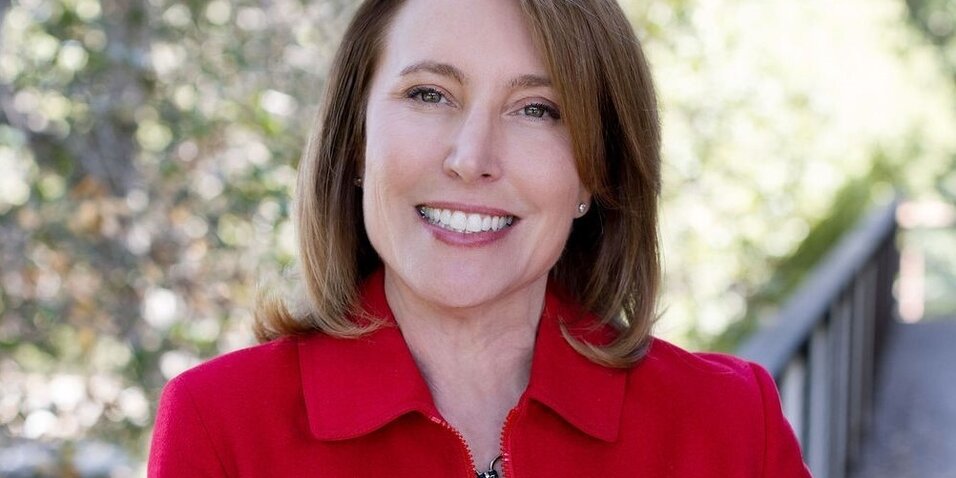
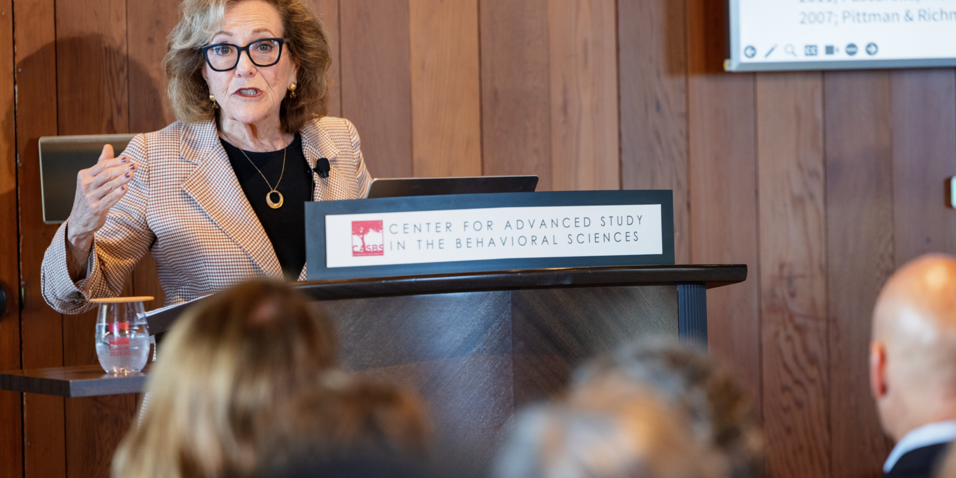
“Before I start, I want to welcome a guest. Bob Scott, dear friend, was associate director of CASBS from 1983-2001 and then again in 2009-10. Bob and I go back 55 years. His lectures in a very large lecture course at Princeton inspired me to become a sociologist. I’m so very, very honored.”
So began David Stark, a 2025-26 CASBS fellow, moments before delivering his research seminar to an assemblage of his cohort fellows and a smattering of staff on October 8, 2025 in CASBS’s Margaret Levi Meeting Room. Stark gestured toward the left side of the room near the back, where Bob Scott was sitting. Everyone in the room turned their heads in Scott’s direction.
“He’s my fault!” exclaimed Scott. The room erupted in laughter, delaying the presentation by another ten seconds or so.
Any publicly expressed bond between two people that extends back more than a half-century is probably worth exploring a little more. But this one involves Bob Scott. Scott devoted his legendary second career to CASBS after serving as a sociology professor at Princeton University. As the Center’s associate director for nearly two decades, Scott’s imprint was so indelible that a lectureship fund at CASBS was established in his name a decade ago, made possible by about 135 former fellows who contributed to the fund. (You’ll find David Stark’s name on the list of contributors.) In retirement in nearby San Francisco, Bob has remained a fierce champion of the Center, attending most of its public events (often with his wife, Julia) and occasionally advising a few of us behind the scenes. The latest iteration of a Bob passion project, a compendium of essays called Emerging Trends in the Social and Behavioral Sciences, became open access on the Center’s website in 2022. Bob talked about it on the CASBS podcast, in an episode called “Bob Scott is Trending.” He’ll even turn up in a CASBS story about others from time to time.
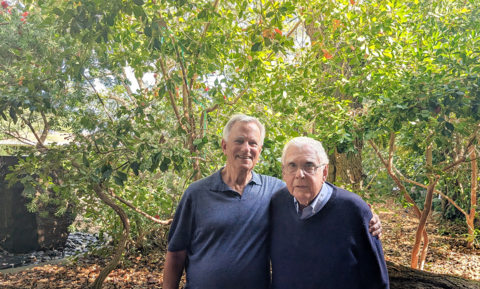
So, yeah, this makes us even more interested in David Stark’s warm welcome to his invited guest on October 8.
We decided to get out of the way and asked both David and Bob if they were willing to reveal more about their connection, particularly its origins. Here’s what they shared with us.
Bob Scott and I go back quite a long time – more than 50 years – to my undergraduate days at Princeton where I had some great teachers. Especially memorable was a course in the history department, in which the lecturer was the legendary Carl Schorske (a CASBS fellow in 1959-60 and 1965-66) and the teaching fellow in my “precept” (Princeton’s nomenclature for discussion section) was Robert Darnton (CASBS fellow 1973-74). Also, I had wonderful mentors in the Sociology Department: Melvin Tumin during my senior year and Suzanne Keller, my advisor throughout, already from my freshman year. Suzanne was the first (and at the time the only) woman who was a tenured faculty member in the entire university.
But it was Bob Scott whose exemplary lecturing inspired me to become a professor of sociology. I enrolled in his undergraduate lecture course. To say it was a large course would be an understatement. It met in McCosh 50, the largest lecture hall at Princeton. It has 444 seats (I just looked it up), and the place was packed from the bottom floor to the balcony. It was 1970, the height of student (and faculty) protests against U.S. aggression in Vietnam and, correspondingly, the height of enrollments and majors in sociology.
What was Bob like as a lecturer? It was serious stuff, presented in a manner that was lively, puzzling, thought provoking. And enriched with humor. Bob wasn’t “funny.” None of this “let’s have fun.” It was much deeper and so much better. To get the humor, you had to pay attention. If you did, as many students did learn to do, it was richly rewarding. It was completely serious, done with a glimpse of amazement at the human condition. To say one “enjoyed it” just doesn’t do it justice. It was more like you were in the presence of someone who had a profound sense of joy. A quality all too rare. Just think, to do that, standing up in front of a group of people, twice a week for 13 weeks! It must have been difficult. But the guy was doing it. Every time. Oh, my, I thought. Someone can really do this? That’s amazing. It’s wonderful, I could do this. It is possible. OK. Do it. Thanks, Bob.-David Stark
I first met David when he enrolled in a lecture course I taught at Princeton University. There were over 400 students in the class, which made it challenging for me to get to know very many of them personally. That said, David stood out above the others. I immediately spotted him as a promising, budding young sociologist and remember encouraging him to major in our subject. When he did, he became much more than just your ordinary garden variety undergraduate major; he became more like a colleague to those of us on the faculty. I can remember conversations I had with several of my fellow faculty members whose courses David took. They found him unusually perceptive, hard-working, and serious, head and shoulders above other majors in our department. All of us were delighted with the news that he was planning to pursue graduate study and we have followed his remarkable career with interest ever since.
Years past, I left Princeton to join the staff of the Center, and you can imagine my delight when he was invited to spend a fellowship year at CASBS that happily took place on my watch (in 1995-96). It was a genuine delight to welcome him to CASBS and to see how much his research and writing had matured and developed into the work of a first-rate sociologist. My appreciation for his work only deepened when I had the pleasure of attending his seminar this year when he returned for a second fellowship, to hear him talk about his latest research about a fundamentalist church in his native Oklahoma.Though we share a common bond as fellow sociologists, there is another bond we also share that he may not be fully aware of. David comes from a modest background in Oklahoma, hardly a place from which the typical Princeton undergraduate of his day came. He found himself in an environment densely populated with the sons, and occasionally daughters, of privilege, students from wealthy families, many of whom had attended elite private schools. Since my own roots are from a small, dying coal mining town in eastern Pennsylvania and raised in a family of extremely modest means, I empathized with the challenges he faced in the environment Princeton offered. Though he may not have known it, at the time I had an abiding respect for the way in which he handled himself as something of an outsider in a world marked by privilege. I have often thought that this experience of being something of an outsider helped contribute to making him the fine research scholar he is today, someone with an ability to stand back and away from the swim of things and analyze and understand social life more deeply and perceptively than others. In reconnecting with him once again this year it has been rewarding for me to see how the qualities of empathy and understanding that his background gave him are reflected in his work. It makes a person proud to have had some role, however minor, in launching his remarkable career and now to be able to call him my friend.
-Bob Scott