The Tyler Collection: CASBS's Gift to the Social Sciences
The inaugural CASBS fellows class took residence at the Center in September 1954. The first books emerging from that fellowship year – worked on in some capacity by fellows while they were fellows – were published in 1955. There are two, or at least two we know about: The Language of Social Research: A Reader in the Methodology of Social Research, co-edited by Paul Lazarsfeld (the other editor, Morris Rosenberg, became a CASBS fellow in the 1956-57 academic year); and The Thematic Apperception Test: An Introductory Manual for its Clinical Use with Adults, by Morris I. Stein.
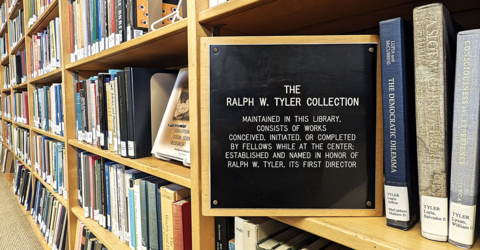
Copies of the two were the first to enter what became and continues to be one of the world’s most renowned book collections of – and its authors among the most distinguished scholars of – post-War social and behavioral science research and inquiry. Though unnamed at first, the collection eventually was dedicated in honor of the Center’s founding director, Ralph Tyler, who led CASBS from 1954 to 1966.
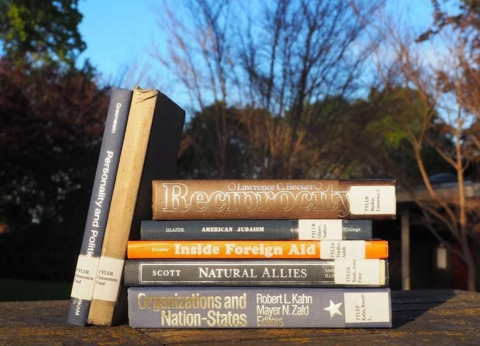
![The Ralph W. Tyler Collection, located within CASBS's Ruth H. and John G. Neukom Reading Room [CASBS files]](/sites/default/files/styles/large/public/media/image/tyler_collection_11-17-25_1200_0.png?itok=dLZqAQKq)
In 2025, the Center commemorates 70 years of the Ralph W. Tyler Collection. Earlier in the year, the collection also surpassed 2,000 volumes, a second milestone worthy of celebration.
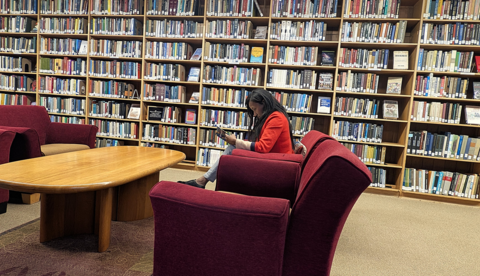
For the uninitiated, the Tyler Collection is the furthest thing from a museum piece of untouchable, stodgy, cobweb-covered books under lock and key. Rather, it’s a living, breathing collection accessible to those working under the Center’s umbrella, and thus requires continuous maintaining. It expands at a pace of about 15-20 new entries per year and resides in the Center’s Ruth H. and John G. Neukom Reading Room.
“Though the room doesn’t grow, the collection does. Each year it’s an increasing challenge to create new shelf space, but it’s a good problem to have,” said Jason Gonzales, CASBS’s librarian tasked with administering the collection since 2015. “It’s gratifying when fellows check out Tyler books from the library or when library staff find Tyler books lying on tables in the reading room. It means the books, some decades old, remain relevant to contemporary social science research and problem solving.”
Fellows and visitors alike will attest that nothing beats the tactile experience of browsing the physical Tyler Collection and pulling books from their shelves. The insights and thought leadership are in one’s hands, inches from one’s face. The public can view a 413-page list of Tyler books on the Center’s website, and use a search field to look for Tyler books by author, title, publisher, or fellowship year.1 A separate web page highlights books entered into the Tyler Collection in the past 10 years or so.
But in its early decades, before the internet and online databases, details about the collection, or even evidence of its existence, were difficult for the intellectually curious among the public to discover. The collection was known largely among fellows and those in their professional networks. As former director Gardner Lindzey put it, the Center maintained “a tradition of relative obscurity” in its secluded location and “generally pursued a policy of quiet avoidance of the public gaze.” When the Center printed its first bibliography of the Tyler Collection in 1979, Lindzey noted that the list represented “the most objective and tangible evidence of the Center’s fruitfulness” as well as “an acceptance of responsibility for increased communication with the external world.”2 In 1995, director Neil Smelser struck similarly muted tones shortly after the Center celebrated its 40th anniversary, the collection having doubled in size since the late 1970s.3
Though the Center today engages in robust external outreach efforts along a number of dimensions, for many the collection – or specific books and fellows represented within it — remains the Center’s principal calling card, embodying a benchmark of excellence to which other scholarly institutions aspire.
Once one becomes familiar with the Tyler Collection, and through whatever means, one thing is clear: it is the jewel in the Center’s crown and a gift to the social and behavioral sciences enterprise. As Pulitzer Prize-winning author and 2014-15 CASBS fellow Paul Starr put it:
If you go into the Center’s library and look at the Tyler Collection, you will see literally hundreds of books written at the Center — evidence that the trail of individual curiosity social scientists have followed here has led to a remarkable trail of accomplishment. Although there is no way to measure the Center’s exact impact, without its support many of those books would not have been written, or would have been less ambitious, and as a result the social sciences and intellectual life would have been much the poorer.4
The collection consists of books that were conceived, begun, drafted, completed, or otherwise worked on by fellows while in residence as fellows. In almost all cases, authors recognize the Center in some way (often effusively, which we love) in their books’ acknowledgments. Some contain handwritten author inscriptions. Many Tyler books have initiated new lines of inquiry, defined new fields, reviewed or summarized broad areas of research, proposed new theoretical perspectives, and refined methodological and analytical techniques. And some are classic, foundational works exerting significant influence on academic discourse, contemporary thought, governance, or public policy.
A select and, some may say, arbitrary sampling of Ralph W. Tyler Collection gems:
Anarchy, State, and Utopia
Robert Nozick (fellow 1971-72)
A Southern Odyssey: Travelers in the
Antebellum North
John Hope Franklin (1973-74)
A Theory of Cognitive Dissonance
Leon Festinger (1955-56)
A Theory of Justice
John Rawls (1969-70)
After Hegemony: Cooperation and Discord
In the World Political Economy
Robert O. Keohane (1977-78, 1987-88, 2004-05)
Attachment and Loss
John Bowlby (1957-58)
Class and Conflict in Industrial Society
Ralf Dahrendorf (1957-58)
Citizens, Elections, Parties: Approaches to the Comparative Study of the Processes of Development
Stein Rokkan (1959-60, 1966-67)
Dynamics of Contention
Douglas McAdam (1991-92, 1997-98),
Sydney Tarrow (1980-81, 1997-98), &
Charles Tilly (1997-98)
Exit, Voice, and Loyalty
Albert Hirschman (1968-69)
Gender and Discourse
Deborah Tannen (1992-93, 2012-13)
Knowledge and Decisions
Thomas Sowell (1976-77)
Language and a Woman’s Place
Robin Lakoff (1971-72)
Making Democracy Work: Civic Traditions in Modern Italy
Robert D. Putnam (1974-75, 1988-89)
Objectivity, Relativism, and Truth
Richard Rorty (1982-83)
Organizations
James March (1955-56, 1973-74) & Herbert Simon
Orientalism5
Edward Said (1975-76)
Passion: An Essay on Personality
Roberto Mangabeira Unger (1982-83)
Political Man: The Social Bases of Politics
Seymour Martin Lipset (1955-56, 1972-73)
Railroaded: The Transcontinentals and the Making of Modern America
Richard White (2003-04)
Stone Age Economics
Marshall Sahlins (1963-64)
The Adapted Mind: Evolutionary Psychology and the Generation of Culture
Jerome Barkow, Leda Cosmides (1989-90),
John Tooby (1989-90), eds.
To scholars, students, and fans of the social and behavioral sciences, this is a stunning selection of books and authors. Any former CASBS fellows whose book enters the Tyler Collection claim this company, their book residing on the same shelves. New entries may well physically sit adjacent to classics, as the collection is arranged in alphabetical order by authors’ last names. Among most CASBS fellows, a vibe of reverence is palpable.
“The prospect of entering the Tyler Collection at CASBS always filled me with veneration and awe,” said 2018-19 fellow Dan Kelly, whose book (coauthored with 2019-20 fellow Michael Brownstein and Alex Mavda) Somebody Should Do Something: How Anyone Can Help Create Social Change entered the collection in October 2025. “Now, I am extremely proud to have our book join the ranks of all the other incredibly smart, pathbreaking, and just cool work contained on its shelves. Frankly, I’m kind of humbled, too.”
As with the entire collection, the list of classics within it is living and breathing, meant to be discussed, debated, and refined. Former fellows no doubt will quibble with or bemoan specific inclusions as well as omissions.6 Moreover, invariably some ‘classic’ books withstand the passage of time less well than others. New bodies of evidence and modes of thinking emerge. Collective tastes, preferences, and epistemologies gradually, and occasionally quickly, shift. As a result, some books risk losing their ‘classic’ or ‘gem’ status in the minds of many. Something resembling the “objective,” definitive list of Tyler classics, fixed in our minds and in time, likely will and probably should remain elusive.
At any rate, a focus solely on the Tyler classics necessarily draws attention away from hundreds upon hundreds of excellent, influential, impactful Tyler Collection books that are dear to the subjective hearts and minds of readers generally and CASBS fellows specifically. So, to widen our view of the collection, we reached out to a bunch of (mostly) recent CASBS fellows, asked them to identify their favorite Tyler Collection book (or two or three), and explain their choice in just a couple of sentences. View their selections and explanations of them below on this page.
But the sample is modest! Accordingly, here’s our request of all former CASBS fellows:
Do you have a favorite Tyler Collection book? One that has intellectually influenced or inspired you more than others? Or how about one that has changed the course of your discipline or sub-discipline? It doesn’t have to be a known ‘classic’ – just an important or fascinating book, in your estimation.
If one comes to mind, please identify the book, write one-to-four sentences explaining why it means so much to you, and send your thoughts to casbs-news@stanford.edu. We will add your contributions to this web page, displayed with those appearing below, in what we hope will be an ever-expanding set of testimonials for readers to view. Please participate!7
And there certainly are untold missing Tyler Collection books (and possibly a classic or two) because they never were entered into the collection in the first place. Already by 1979, the time of the first printing of an official accounting of the Tyler Collection, CASBS director Gardner Lindzey referred to the bibliography as “undoubtedly incomplete.” Why? Fifteen years later, in the next iteration of the bibliography, director Neil Smelser shed a little more light on the incompleteness, noting an awareness that “many other books qualify but have not been sent to our library for the collection.” Smelser was alluding to the fact that – particularly in the pre-email era – it was sometimes difficult to maintain communication with former fellows and learn about their new, Tyler-eligible book publications. By the same token, many former fellows completing Tyler-eligible books – sometimes many years post-CASBS fellowship – neglected to inform the Center about their books’ existence in the world. The incompleteness of the collection persists to some degree today, notwithstanding occasional appeals by the Center through emails and e-newsletters.
In the preface of the 1995 Tyler bibliography, Smelser wrote: “We hope this publication will spur [book] donations from authors whose books directly resulted from their fellowship year.” So, too, today, in collaboration with former CASBS fellows, we reach toward a still more complete Ralph W. Tyler Collection while celebrating its latest milestones.
* * *
Former fellows: please alert the Center about your Tyler-eligible books not yet residing in the collection (casbs-library@stanford.edu). We’d love it if you’d send us a copy. If sending us a copy is not feasible, ask your publisher to send CASBS a courtesy copy. They almost always readily agree. Or perhaps we can purchase a copy once informed about your book.
Endnotes
1 Viewers on the website also will notice a Tyler Collection of journal articles, a project launched in 2017 to locate and link to journal articles conceived, developed, or completed by fellows while they were in residence as fellows.
2 Gardner Lindzey in preface to “The Ralph W. Tyler Collection: 1954-1979,” pp. 2-3 [CASBS files]. The first published list of Tyler books coincided with the Center’s 25th anniversary in 1979. Lindzey, the Center’s longest-serving director (1975-1989), also was a three-time fellow (1955-56, 1963-64, 1971-72).
3 Neil J. Smelser preface to “Ralph W. Tyler Collection: 1954-1995,” pp. i-ii [CASBS files].
4 Paul Starr speech delivered at CASBS’s 60th anniversary celebration, 9 November 2014 [CASBS files].
5 Listen to “In Edward Said’s Shadow,” an episode of the CASBS podcast, Human Centered, about Orientalism on the CASBS website or on any of the major podcast apps.
6 But alert us to glaring errors! We welcome perspectives and commentary from across the CASBS community (casbs-news@stanford.edu). Upon examination, our classics list is notable for its dearth of female authors, an unfortunate reflection of the gender composition of fellows classes during the Center’s first few decades. One expects the number of classic Tyler books written by female fellows to increase when the Center staff or others compile updated ‘classics’ lists in the future.
7 We hope former fellows will think broadly across the collection; we’d like to display comments across as wide a range of books as possible – there are more than 2,000 volumes to choose from! Not sure if the book you have in mind is in the Tyler Collection? Search for it on our public website.