Woody's Dedication
By his own accounting, he has spent a total of about 15 years of his academic career at CASBS – as a two-time fellow (well, three-time fellow, unofficially), organizer of summer institutes, faculty fellow, interim director, and fellowship selection committee member. Among other things, that’s hundreds of CASBS lunches consumed and research seminar talks attended. And great scholarship produced, too,1 with more anticipated.
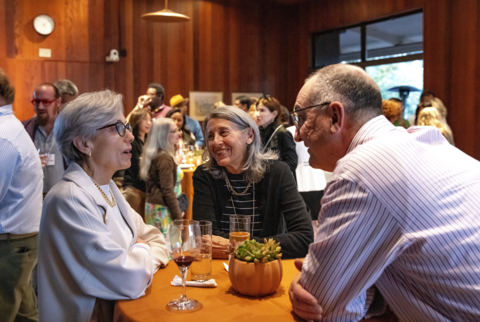
An impressive amount of time spent on the hill, unquestionably. But the numbers alone don’t supply the real reasons why nearly one hundred people gathered at CASBS on November 6, 2025 (and dozens of others sent congratulations and well wishes) to celebrate Walter W. “Woody” Powell, the Jacks Family Professor of Education at Stanford, and the dedication of a CASBS study in his name.
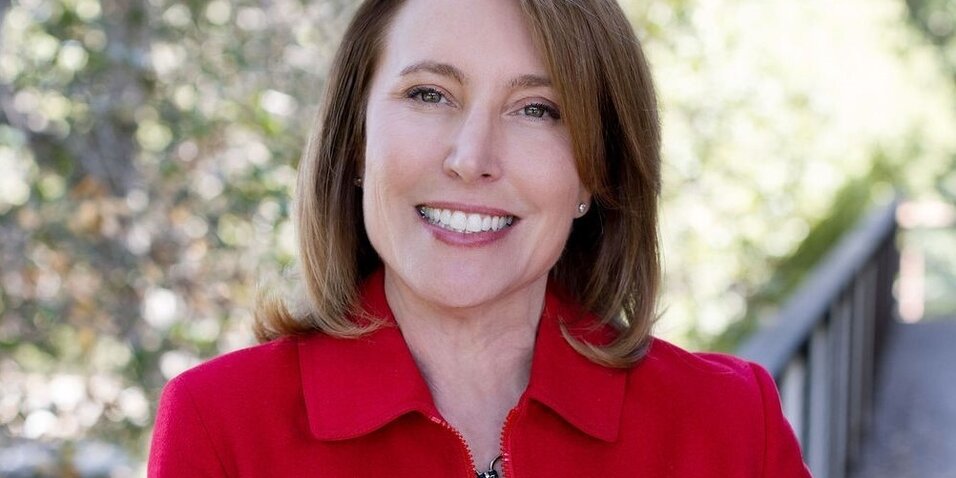
On a practical level, it takes some fundraising to make it happen. During her tenure as CASBS director (2023-25), Sarah Soule spearheaded an effort to raise sufficient funds enabling endowment of a study, mainly through outreach to scores of current and former Powell students, collaborators, colleagues, and participants in CASBS’s summer institute on “Organizations and Their Effectiveness,” which Powell co-directed for a decade starting in 2016. (Notably, Soule herself was a colleague of Powell’s in the 1990s at the University of Arizona, before both separately joined Stanford.) Soule, now the dean of Stanford’s Graduate School of Business, was on hand for the Powell celebration.
Powell knew nothing of the effort, he would tell the crowd, until he started receiving notes from Stanford’s Office of Development informing him, to his surprise, that gifts were being made in his honor.
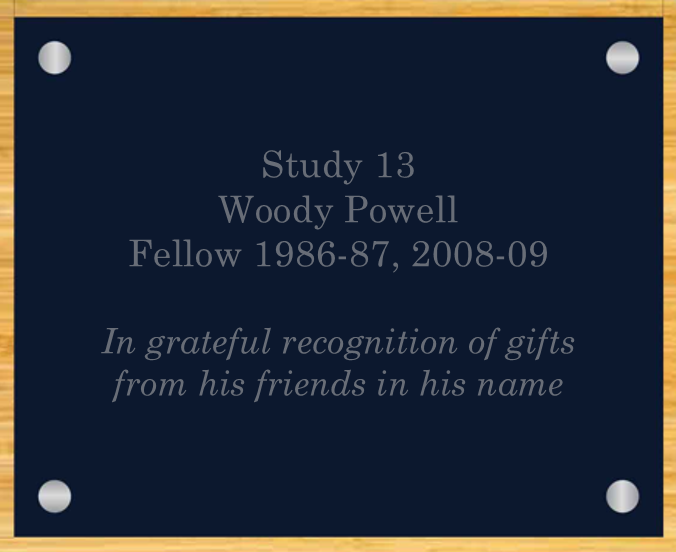
The result is a plaque to be created in grateful recognition of gifts from contributors – friends – in Woody’s name. The plaque will display outside study #13, which he occupies now and has since 2023. (He has occupied studies #2, #12, and #40 in previous stints at the Center.) This is a big deal. Over the course of CASBS history, study #13 has been occupied by several towering fellows. This includes, among others, George Stigler and George Schulz, that latter of whom Woody got to know and admire upon joining Stanford; and two others who specifically drew Woody to that study: Robert K, Merton, an “intellectual grandparent” and titanic figure of modern sociology, and Robert Dahl, an eminent senior faculty member and political scientist at Yale who was a receptive sounding board when Woody was a junior faculty member there.
“Study #13 also has the best location at the Center,” Woody contends.
In accordance with Stanford rules regarding recognition, however, a plaque cannot be mounted until Woody retires from the university. So, instead, the assembled crowd on November 6, including Woody himself, was shown a graphic rendering of the plaque, revealed by Lara Tiedens, CASBS’s Sara Miller McCune Interim Director and the event's master of ceremony, on the Center’s Margaret Levi Meeting Room screen. (View the graphic at the bottom of this page.)
But what happened on the practical, fundraising level never would have been proposed or even possible were it not for the universal consensus (as far as we can tell) that Woody Powell personifies what a scholarly community member should be. Sure, he (presumably) models this wherever his professional pursuits take him, whether on the flatlands of the Stanford campus (where he holds multiple courtesy appointments) or far beyond. But because he has been who he is for about 15 years of his career here, on the CASBS hilltop, he has achieved certifiable super-community member status here. He bleeds CASBS red.
That’s why Woody is the exception who gets his own CASBS study every year (something typically reserved only for current academic year residential fellows and visiting scholars), why the crowd gathered on November 6 to celebrate him, why some spoke about what Woody means to them and others, and why Woody spoke about what CASBS means to him.
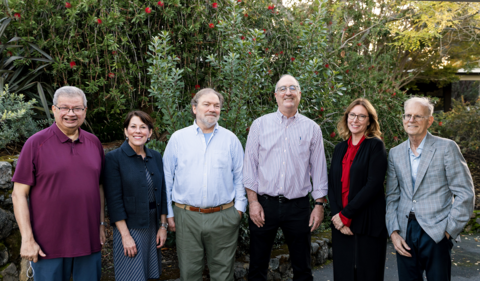
Recurring themes among the non-Woody speakers were his curiosity and generosity, his kindness and mentorship, his impact on people’s scholarly trajectories, and his unwavering dedication to cross-disciplinary inquiry, exploration, and exchange.
Paul Ricci, a member of the CASBS board of directors, a former CEO, and longtime financial supporter of the “Organizations and Their Effectiveness” summer institute Woody co-directs, recalled reading, year after year, exit summaries from dozens of institute participants, all effusively praising Woody and how he made a difference in the direction of their professional lives.
“As someone who has run organizations, I can tell you I haven’t gotten nearly as many great testimonials – in 40 years from tens of thousands of employees,” he said as the audience erupted in laughter. “So, I feel a little embarrassed. What a rare skill it is…congratulations to you, Woody, for your accomplishments.”
Fred Turner, a two-time CASBS fellow and the Harry and Norman Chandler Professor of Communication at Stanford, explained that as a new scholar with a decade of prior experience as a journalist, he didn’t know how to make sense of what this new thing at the time, the internet, meant for media studies and how and why people do things together. But it became apparent that organizational sociology suddenly was becoming a key for advancing understanding. Woody soon became his “gatekeeper,” showing him how to think “not just about the fish, but really about the water – the structures through which we swim to live our lives.” But it went beyond mere guidance.
It's hard to overstate Woody’s kindness. It’s really scary when you’re a new professor or a new student trying to make your way and have new ideas, then meet someone as accomplished as Woody. The scholarship Woody has done is just enormously impressive. You all know that. But what astonishes you is not only the scale and flexibility of his thinking, but the generosity, the kindness, his encouragement, his interest in your becoming ever more you with his help. And there’s just no greater thing that you can do for a young scholar than what he has done for me – and for many others.
Hayagreeva “Huggy” Rao, a former CASBS fellow, Woody Powell collaborator, and the Atholl McBean Professor of Organizational Behavior and Human Resources at Stanford, expressed it, at times colorfully, in terms of extra genes Woody evidently possesses – a curiosity gene and a generosity gene, neither of which have an off switch.
It’s incredible. His bandwidth is stunning. First, I thought he was Wikipedia. Then I thought he was an LLM. But my god, he’s funny and he’s human. Ask him something. Before you know it, he’s told you about three books and four articles you should read and shared five stories about various protagonists in that sub-field. It’s generosity of spirit – he’s not a dragon hoarding gold. He shares everything.
And it’s one thing to say Woody has a legacy of incredible papers and citations, which of course he does. But what he also has is a legacy of people – people to whom he has been kind. Now, many who are kind and generous, they really want the light to shine on themselves. But Woody is a remarkable exception. He actually shines a light on other people and on other things so that we can all see more clearly.
Sarah Soule reflected on the beginning of their colleagueship and Woody’s mentorship, noting his gift for asking insightful questions in a way that enabled her to see her own ideas and hear her own voice much more clearly, shedding light on the direction those ideas and that voice needed to travel. And over the years, she has witnessed him do the exact same thing with countless other scholars, including CASBS fellows.
He’s somebody whose generosity of spirit never, ever runs dry. And so, when the opportunity arose to name a study here at CASBS in his honor, it just felt like the right thing to do, and this was the right place to do it, because this – as those of you who have been touched by this place know – is a community of ideas, of conversation, and of connection, and all of that embodies exactly what Woody stands for. As we dedicate the study, we celebrate Woody, his intellectual generosity, his unending curiosity, his depth of joy over shared intellectual discovery, and the countless ways he’s made us better scholars and CASBS a better place.
You get the idea. In just this small sample, one detects a clear pattern in the remarks that assuredly would have continued if others had been allowed a turn at the lectern and the event allowed to drift into multiple hours. No doubt there will be more opportunity for that upon Woody’s retirement, whenever that happens.
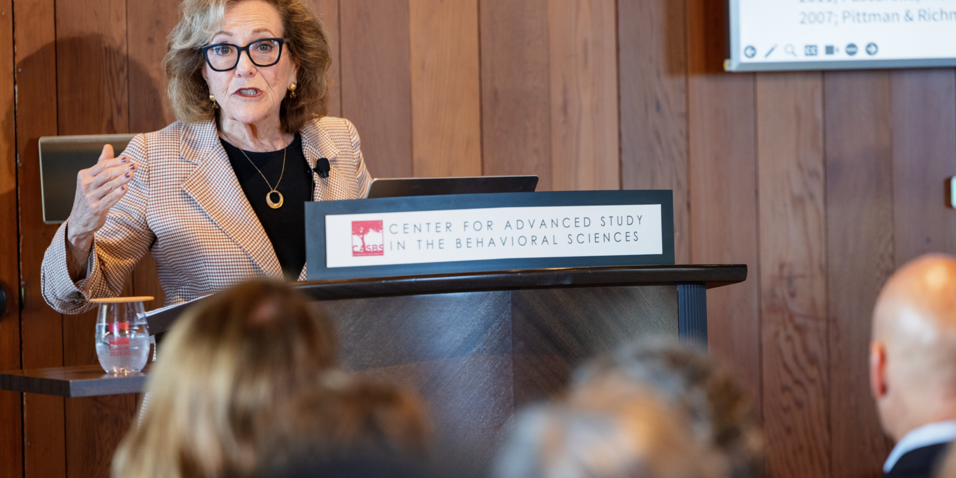
Moments after CASBS director Lara Tiedens revealed the graphic image of the plaque, she perfectly distilled collective sentiments.
We’re truly thrilled to have study #13 bear your name. And we know that your real legacy is in the intellectual community that you’ve nurtured here and elsewhere with such generosity and integrity. So, to Woody, a scholar, leader, and friend of CASBS.
For Woody Powell, the collegiality and mentorship for which he’s renowned flow in both directions. Now, at this stage of his career, he’s passing it on. In a recent essay, he reflects on his own journey – specifically, his experiences with extraordinary mentors and his decades of experience as a mentor. The way mentorship is a reciprocal relationship fostering mutual growth and respect. In fact, in recent years, he and summer institute co-director (and two-time CASBS fellow) Robert Gibbons have learned through interaction with participants in “Organizations and Their Effectiveness” that “the best mentorship is not about shaping others – it is about growing together.”2
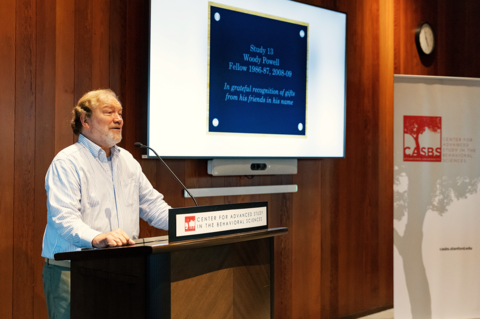
The essay speaks for itself, aspects of it resonating with the comments of those who spoke before Woody on November 6. At the lectern himself, he gave thanks – to Lara Tiedens and CASBS deputy director Sally Schroeder for organizing the event; to Sarah Soule for hatching and executing the study dedication idea; to Paul Ricci for his steadfast support of the summer institute, “an extraordinary investment in the future of the social sciences;” to CASBS board of directors chair Abby Smith Rumsey, board members Roberta Katz, Chien Lee, and Kate Stovel (a former CASBS fellow) for all their assistance during his year (2022-23) as CASBS interim director; and to the CASBS staff who make the place run – “its pretty incredible what they do” – so essential to new classes of fellows each year, for sure. But also essential to someone who Lara Tiedens referred to as “a CASBS lifer.”
“I guess there’s something to that,” said Woody, who then proceeded to estimate those 15 years of his career spent at CASBS. “It’s been a big part of my life.” He continued:
What makes this place so special? Why spend so much of your life up here on the hill? Stanford’s a great institution, but I prefer to be up here, because when you drive up the hill, you leave your daily life behind, and you’re surrounded by nature, different sounds, and new friends. This room is magical. And let’s be honest, if you can’t get work done in an office here, you probably ought to look for another job. There are not many places that will free you from constraint. The designers got this place right back in the 1950s. They built a place that lets the light in. It’s pretty extraordinary.
Real as well as metaphorical light. We know CASBS as spatial experience undeniably sets the tone and cleanses the intellectual soul, enabling thousands of scholars and their scholarship to flourish, and in a very unique way, as Woody elaborated while recalling his first CASBS fellowship (1986-87), nearly 40 years ago.
Spending a year at CASBS changes you as a scholar and encourages you to ask different kinds of questions. Perhaps the questions are deeper, perhaps they’re broader, sometimes they’re both. You think about your audience differently. I know this well because when I was a fellow here in my 30s, I was working on papers that were immensely improved by conversations with political scientists, economists, cognitive psychologists. Those papers have had long lives, and I’m really happy that I got to write them here. I think of them all the time when I’m here.
Here, you learn how to ask questions differently. You have to think about a question not as a criticism but as a gift – a gift to the speaker and a gift to the audience. You learn to take intellectual risks. You care more about ideas than academic status. And it’s a shame that universities aren’t more like that. So, for that reason, CASBS can restore you. It can renew you. It can remind you of why you became a scholar in the first place.
Unlike many places in the world, CASBS is a place to be nurtured and enjoyed, and especially now, in this moment in history, to be protected more than ever.
* * *
1 View a list of publications emerging from Woody Powell’s two CASBS fellowships. Among them, Powell wrote his influential article, “Neither Market nor Hierarchy,” winner of the 1991 Max Weber Outstanding Scholarship Award from the Organizations and Occupations section of the American Sociological Association, during his first CASBS fellowship. Powell’s collaborations with former CASBS fellow (1984-85) Paul DiMaggio are considered seminal within organizational theory. Their now-classic book, The New Institutionalism in Organizational Analysis (1991), was initiated at a conference during Powell’s first CASBS fellowship. Both works have been cited more than ten-thousand times.
2 Walter W. Powell, “Passing It On,” Sociologica v18n3: 37-47 (2025).